100 yen coin

 Clash Royale CLAN TAG#URR8PPP
 Japan | |
| Value | 100 Japanese yen |
|---|---|
| Mass | 4.8 g |
| Diameter | 22.6 mm |
| Shape | circular |
| Composition | Copper 75%, Nickel 25% |
| Years of minting | 1957–present |
| Obverse | |
 | |
| Design | Sakura blossoms |
| Design date | 1967 |
| Reverse | |
 | |
| Design | "100" in Arabic numerals |
| Design date | 1967 |
The 100 yen coin (百円硬貨, Hyaku-en kōka) is a denomination of Japanese yen. The current design was first minted in silver in 1959 and saw a change of metal in 1967.[1] It is the second-highest denomination coin in Japan after the 500 yen coin.
Contents
1 History
2 Composition
3 Commemoratives
4 Designs
5 Circulation figures
5.1 Shōwa
5.2 Heisei
6 References
History
The first 100 yen coin was issued in 1957 and featured a phoenix on the reverse. It featured Latin script writing in addition to Japanese. This design was issued in 1957 and in 1958.[2]
In 1959, the design was modified, removing the Latin script, and changing the reverse side to show a sheaf of rice. The metallurgy remained unchanged. This design was issued every year from 1959 to 1966.[3]
The current design for the 100 Yen coin was first issued in 1967. The metallurgy was changed from the former 60-30-10 ratio of silver-copper-zinc to a ratio of 75-25 copper-nickel, with the weight and diameter of the coin unchanged. The reverse side was changed to show sakura blossoms and the denomination in Japanese.
The coin shares, with the 50 yen coin, the emperor's rule date (28 in 2016) expressed with Arabic numerals instead of in Japanese numerals.
Composition
| Years | Material[4] |
|---|---|
| 1957-1958 | 60% silver, 30% copper, 10% zinc |
| 1959-1966 | 60% silver, 30% copper, 10% zinc |
| 1967-Present | 75% copper, 25% nickel |
| 2015-Present | 87.5 % copper, 12.5% nickel |
Commemoratives
- In 1964, a 100 yen coin was issued to mark the 1964 Olympic Games in Tokyo. The obverse featured the Olympic torch and Olympic rings while the reverse re-introduced Latin script.[5]
- In 1970 a 100 Yen coin was issued to mark Expo 70 in Osaka.[6]
- In 1972 a 100 yen coin commemorated the 1972 Winter Olympics in Sapporo. The Olympic Torch remained on the obverse while the rings moved to the reverse.[7]
- A coin marked Expo '75 in Okinawa.[8]
- In 1976 a 100-yen coin marked the Golden Jubilee of Emperor Hirohito. A large chrysanthemum, symbolising the Japanese Imperial Family, featured on the reverse.[9]
- In 2015, a new series of 100 yen coins was introduced to commemorate the 50th Anniversary of the inauguration of the Tōkaidō Shinkansen train service. The coins are minted under a different composition of cupronickel, consisting of 87.5% copper and 12.5% nickel.[10]
- To commemorate the 2020 Tokyo Summer Olympics and 2020 Tokyo Summer Paralympics, a new series of 100 yen coins will feature designs showcasing images of the sporting events taking place.[11]
Designs
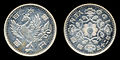
1957–1958
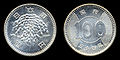
1959–1966

1964 Olympic commemorative

1967–present

1970 Expo commemorative


Circulation figures
Shōwa
The following are circulation dates which cover Emperor Hirohito's reign. The dates below correspond with the 32nd to the 64th year (last) of his reign. One hundred yen coins had three main different designs, but there was no overlap in mintage between them. Coins for this period will all begin with the Japanese symbol 昭和 (Showa).
- Japanese coins are read with a left to right format:
- "Emperors name" → "Number representing year of reign" → "Year" (Ex: 昭和 → 53 → 年).
| Year of reign | Japanese date | Gregorian date | Mintage (thousands)[4] |
|---|---|---|---|
| 32nd | 三十二 | 1957 | 30,000 |
| 33rd | 三十三 | 1958 | 70,000 |
| 34th | 三十四 | 1959 | 110,000 |
| 35th | 三十五 | 1960 | 50,000 |
| 36th | 三十六 | 1961 | 15,000 |
| 37th | 三十七 | 1962 | 0 |
| 38th | 三十八 | 1963 | 45,000 |
| 39th | 三十九 | 1964 | 10,000 |
| 40th | 四十 | 1965 | 62,500 |
| 41st | 四十一 | 1966 | 97,500 |
| 42nd | 四十二 | 1967 | 432,200 |
| 43rd | 四十三 | 1968 | 471,000 |
| 44th | 四十四 | 1969 | 323,700 |
| 45th | 四十五 | 1970 | 237,100 |
| 46th | 四十六 | 1971 | 481,050 |
| 47th | 四十七 | 1972 | 468,950 |
| 48th | 四十八 | 1973 | 680,000 |
| 49th | 四十九 | 1974 | 660,000 |
| 50th | 五十 | 1975 | 437,160 |
| 51st | 五十一 | 1976 | 322,840 |
| 52nd | 五十二 | 1977 | 440,000 |
| 53rd | 五十三 | 1978 | 292,000 |
| 54th | 五十四 | 1979 | 382,000 |
| 55th | 五十五 | 1980 | 588,000 |
| 56th | 五十六 | 1981 | 348,000 |
| 57th | 五十七 | 1982 | 110,000 |
| 58th | 五十八 | 1983 | 50,000 |
| 59th | 五十九 | 1984 | 41,850 |
| 60th | 六十 | 1985 | 58,150 |
| 61st | 六十一 | 1986 | 99,960 |
| 62nd | 六十二 | 1987 | 193,775 |
| 63rd | 六十三 | 1988 | 363,112 |
| 64th | 六十四 | 1989 | 0 |
Heisei
The following are circulation dates in the reign of the current Emperor. Akihito was crowned in 1989, which is marked with a 元 symbol on the coin as a one year type. Coins for this period all begin with the Japanese symbol 平成 (Heisei).
- Japanese coins are read with a left to right format:
- "Emperors name" → "Number representing year of reign" → "Year" (Ex: 平成 → 16 → 年).
| Year of reign | Japanese date | Gregorian date | Mintage (thousands)[4] |
|---|---|---|---|
| 1st | 元 | 1989 | 369,000 |
| 2nd | 二 | 1990 | 444,953 |
| 3rd | 三 | 1991 | 375,120 |
| 4th | 四 | 1992 | 211,130 |
| 5th | 五 | 1993 | 82,240 |
| 6th | 六 | 1994 | 81,767 |
| 7th | 七 | 1995 | 92,874 |
| 8th | 八 | 1996 | 237,213 |
| 9th | 九 | 1997 | 272,086 |
| 10th | 十 | 1998 | 252,612 |
| 11th | 十一 | 1999 | 179,120 |
| 12th | 十二 | 2000 | 172,026 |
| 13th | 十三 | 2001 | 8,024 |
| 14th | 十四 | 2002 | 10,667 |
| 15th | 十五 | 2003 | 98,406 |
| 16th | 十六 | 2004 | 204,903 |
| 17th | 十七 | 2005 | 300,029 |
| 18th | 十八 | 2006 | 216,594 |
| 19th | 十九 | 2007 | 129,904 |
| 20th | 二十 | 2008 | 93,811 |
| 21st | 二十一 | 2009 | 115,003 |
| 22nd | 二十二 | 2010 | 67,905 |
| 23rd | 二十三 | 2011 | 178,936 |
| 24th | 二十四 | 2012 | 402,211 |
| 25th | 二十五 | 2013 | 608,892 |
| 26th | 二十六 | 2014 | 445,013 |
| 27th | 二十七 | 2015 | 410,004 |
| 28th | 二十八 | 2016 | 461,064 |
| 29th | 二十九 | 2017 | 518,927 |
| 30th | 三十 | 2018 | - |
References
^ "Operations Coins Currently Minted: Japan Mint". Japan Mint. Archived from the original on 18 October 2009. Retrieved 20 July 2010..mw-parser-output cite.citationfont-style:inherit.mw-parser-output qquotes:"""""""'""'".mw-parser-output code.cs1-codecolor:inherit;background:inherit;border:inherit;padding:inherit.mw-parser-output .cs1-lock-free abackground:url("//upload.wikimedia.org/wikipedia/commons/thumb/6/65/Lock-green.svg/9px-Lock-green.svg.png")no-repeat;background-position:right .1em center.mw-parser-output .cs1-lock-limited a,.mw-parser-output .cs1-lock-registration abackground:url("//upload.wikimedia.org/wikipedia/commons/thumb/d/d6/Lock-gray-alt-2.svg/9px-Lock-gray-alt-2.svg.png")no-repeat;background-position:right .1em center.mw-parser-output .cs1-lock-subscription abackground:url("//upload.wikimedia.org/wikipedia/commons/thumb/a/aa/Lock-red-alt-2.svg/9px-Lock-red-alt-2.svg.png")no-repeat;background-position:right .1em center.mw-parser-output .cs1-subscription,.mw-parser-output .cs1-registrationcolor:#555.mw-parser-output .cs1-subscription span,.mw-parser-output .cs1-registration spanborder-bottom:1px dotted;cursor:help.mw-parser-output .cs1-hidden-errordisplay:none;font-size:100%.mw-parser-output .cs1-visible-errorfont-size:100%.mw-parser-output .cs1-subscription,.mw-parser-output .cs1-registration,.mw-parser-output .cs1-formatfont-size:95%.mw-parser-output .cs1-kern-left,.mw-parser-output .cs1-kern-wl-leftpadding-left:0.2em.mw-parser-output .cs1-kern-right,.mw-parser-output .cs1-kern-wl-rightpadding-right:0.2em
^ http://worldcoingallery.com/countries/display.php?image=img2/97-77&desc=Japan y77 100 Yen (1957-1958)&query=Japan
^ http://worldcoingallery.com/countries/display.php?image=img2/97-78&desc=Japan y78 100 Yen (1959-1966) silver&query=Japan
^ abc "Circulation figures" (PDF). Japan Mint. Retrieved September 28, 2018.
^ http://worldcoingallery.com/countries/display.php?image=img2/97-79&desc=Japan y79 100 Yen (1964) Olympic Games&query=Japan
^ http://worldcoingallery.com/countries/display.php?image=img10/97-83&desc=Japan y83 100 Yen (1970) Osaka Expo&query=Japan
^ http://worldcoingallery.com/countries/display.php?image=img10/97-84&desc=Japan y84 100 Yen (1972) Winter Olympics - Sapporo&query=Japan
^ http://worldcoingallery.com/countries/display.php?image=img10/97-85&desc=Japan y85 100 Yen (1975) Okinawa Expo&query=Japan
^ http://worldcoingallery.com/countries/display.php?image=img10/97-86&desc=Japan y86 100 Yen (1976) 50 yrs of Reign&query=Japan
^ The Tōkaidō Shinkansen commemorative coin series (Tōkaidō Shinkansen N700A) Japan Mint (www.mint.go.jp). Retrieved on 2017-10-05.
^ Designs of The Olympic and Paralympic Games Tokyo 2020 Commemorative Coin Program (First Issue) The Ministry of Finance of Japan (www.mof.go.jp). Retrieved on 2018-03-03.
 | Wikimedia Commons has media related to 100 yen coins. |
Japanese currency | |||||||||||
|---|---|---|---|---|---|---|---|---|---|---|---|
 | Topics |
|  | ||||||||
| Coinage |
| ||||||||||
| Banknotes |
| ||||||||||