Alandi

 Clash Royale CLAN TAG#URR8PPP
Alandi Aalandi | |
|---|---|
City | |
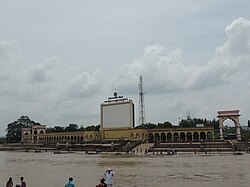 | |
  Alandi Location in Maharashtra, India | |
| Coordinates: 18°40′37″N 73°53′49″E / 18.677°N 73.897°E / 18.677; 73.897Coordinates: 18°40′37″N 73°53′49″E / 18.677°N 73.897°E / 18.677; 73.897 | |
| Country |  India India |
| State | Maharashtra |
| District | Pune |
| Elevation | 577 m (1,893 ft) |
| Population (2011) | |
| • Total | 28,576 |
| Languages | |
| • Official | Marathi |
| Time zone | UTC+5:30 (IST) |
| PIN | 412105 412201 |
Alandi is a town and a municipal council in the Pune district in the state of Maharashtra, India. The town is popular as a place of pilgrimage and the resting place (Samadhi) of the 13th century Marathi Bhakti Sant Dnyaneshwar.
Contents
1 Geography
2 Pilgrimage center
3 Demographics
4 Economy
4.1 Place of pilgrimage
4.2 Agriculture
4.3 Pune suburb
4.4 Education center
5 Education
6 Footnotes
7 Citations
8 References
9 External links
Geography
Alandi (18°40′37.42″N 73°53′47.76″E / 18.6770611°N 73.8966000°E / 18.6770611; 73.8966000[1]) is located on the bank of the Indrayani River, 18.8 km (11.7 mi) in Khed Taluka of Pune District, India, near the northern edge of city of Pune. It has an average elevation of 577 meters (1,893 feet).
Pilgrimage center
Alandi is a well known place of pilgrimage for Hindu Marathi people because of the town's association with the 13th century Varkari Sant Dnyaneshwar. After translating the Hindu scripture Bhagavad Gita from Sanskrit into Marathi, Dnyaneshwar attained sanjivan Samadhi at the Alandi Siddheshwar temple.[2] A temple complex was built at Sant Dnyaneshwar's samadhi and is visited by pilgrims, especially those of the Varkari sect. The Ekadashi of the dark half of each month attracts devotees to the town.[3]
Every year the Paduka (symbolic sandals) of Dnyaneshwar on a Palkhi travel 21 days from Alandi to reach Pandharpur on Ashadhi Ekadashi (June or July in the Gregorian calendar).The palkhi procession is joined by thousands of Varkari devotees for the 150 km journey.[4][5][6]
The biggest festival in Alandi is held every year on Kartika Vadya Ekadashi (the eleventh day of the dark fortnight of the Hindu month of Kartik). The festival falls close to the day Dnyaneshwar entered Samadhi. This festival or yatra is attended by hundreds of thousands of Dnyaneshwar devotees and has a great economic impact for the local population.[7]
Bathing in the Indrayani River has special significance for pilgrims to Alandi. However, the river is heavily polluted because of sewage discharge by towns along its course and contains high amount of Faecal coliform.[8]
Pilgrims perform circumambulation around the town during their visit.
The places of interest to pilgrims in and around Alandi include:
- The Dnyaneshwar Samadhi Complex that includes the Samadhi, the Shri Sidheshwar temple and the famed Ajanvriksha tree[9]
- The ghats on the banks of the Indrayani river
- Ram Mandir near the banks of the Indrayani River, south of the Samadhi mandir, is one of the many large temples in Alandi
- Laxmi Narayan Mandir - is located South to Samadhi mandir, adjacent to Ram mandir, near the River ghat.
Vitthala-Rakhumai Temple- Dnyaneshwari Mandir - modern temple nearing completion, west of Dnyaneshwar Samadhi Complex
- Narsinha Sawaswati Math - west of Dnyaneshwar Samadhi Complex en route to Dnyaneshwari Mandir
- Shree Gajanan Maharaj Temple complex, Alandi – south of Dnyaneshwar Samadhi Complex
- Dnyaneshwar's Wall - According to legend when the arrogant Sant Changdev came to visit Dnyaneshwar on a tiger, Dnyaneshwar and his siblings went to meet him riding on a wall that moved.
- Sant Jalaram Temple: This temple was built in 1960s with the same architectural design as the one in Virpur Gujarat. There is also a temple of Santoshi Mata in the same temple complex.
Nearby places:
- Siddhabet: outside the town where Dnyaneshwar's family was exiled after being ex-communicated.
Sambhaji Raje Bhosle Memorial: in Tulapur village, approximately 6 km from Alandi. A memorial to the son of Chhatrapati Shivaji and the second Chhatrapati of Maratha Empire.
Dehu: the birth, work and worship place of Sant Tukaram and from where the Sant Tukaram flew to Vaikuntha on eagle.[10]

Aalandi laxmi narayan mandir
The town also has dozens of dharmshalas that provide lodgings to pilgrims from their respective communities such as the Padmashali or Maheshwari.[11][12] A number of these places also have their own shrines to different deities and Varkari Sants.
Demographics
In 2011, Alandi had a population of 28,576. Males constitute 56% of the population and females 44%[13]. The lingua franca is Marathi. Alandi has an average literacy rate of 73% (82% of the males, 68% of females), which is lower than the national average of 74.04%. 13% of the population is under 6 years of age. All castes are represented in the town. The closely related Maratha clans, Kurhade-Patil and Ghundare-Patil, dominate civic life of the town.
Traditionally, many Hindu widows would come to reside in places of pilgrimage such as Pandharpur and Alandi[14]
Economy
Place of pilgrimage
The economy of Alandi was historically based around its status as a place of pilgrimage. Although the major festivals in the town are held only twice a year, pilgrims from all over Maharashtra visit the place throughout the year.The needs of the pilgrims are catered for by groups of Brahmins who officiate at the samadhi, weddings, or religious services to the bereaved.Vendors outside the main temple complex offer materials, such as garlands and tumeric, for worshipping at the samadhi along with religious souvenirs and books. Marathi Hindu castes have built Dharmashalas (Pilgrim rest houses) that offer accommodation to pilgrims of their castes. The temple's biggest festival occurs in the second half of the Shaka month of Kartik where the local population earns income by offering accommodation and catering services. The local Municipal council also collects pilgrim or goods tax for public health provision.
Agriculture
As a rural community, farming is an important part of the economy. Groundnut cultivation remains important around Alandi. The produce is sent to oil pressing mills in the industrial town of Chakan.
Pune suburb
Alandi is close to the cities of Pune and Pimpri-Chinchwad and belongs to the Pune Metropolitan Area. Local residents commute to Pune and Industrial areas around Pimpri for employment. The proximity to these places attracts new immigrants to the town who can not afford to live in the more expensive Pune. The local population also is employed with Indian army bases near Alandi. Recently, villages around Alandi have attracted light manufacturing Industry.
Education center
A more recent addition to the economy of Alandi is the MIT Academy of Engineering college. The school has resulted in the development of student housing, eating places, markets, and shops and the overall expansion of Alandi around the college.
Education
- Maharashtra Academy of Engineering
- Sant Dnyaneshwara Vidyalaya
- Sharadchandra Pawar Chitrakala Mahavidyalaya
- Dnyanganga English Medium School and Ramchandra International School
Footnotes
Citations
^ Falling Rain Genomics, Inc. - Alandi
^ Bahirat, B.P. (1998). The philosophy of Jñānadeva : as gleaned from the Amṛtānubhava. Delhi: Motilal Banarsidass. p. 15. ISBN 978-8120815742..mw-parser-output cite.citationfont-style:inherit.mw-parser-output .citation qquotes:"""""""'""'".mw-parser-output .citation .cs1-lock-free abackground:url("//upload.wikimedia.org/wikipedia/commons/thumb/6/65/Lock-green.svg/9px-Lock-green.svg.png")no-repeat;background-position:right .1em center.mw-parser-output .citation .cs1-lock-limited a,.mw-parser-output .citation .cs1-lock-registration abackground:url("//upload.wikimedia.org/wikipedia/commons/thumb/d/d6/Lock-gray-alt-2.svg/9px-Lock-gray-alt-2.svg.png")no-repeat;background-position:right .1em center.mw-parser-output .citation .cs1-lock-subscription abackground:url("//upload.wikimedia.org/wikipedia/commons/thumb/a/aa/Lock-red-alt-2.svg/9px-Lock-red-alt-2.svg.png")no-repeat;background-position:right .1em center.mw-parser-output .cs1-subscription,.mw-parser-output .cs1-registrationcolor:#555.mw-parser-output .cs1-subscription span,.mw-parser-output .cs1-registration spanborder-bottom:1px dotted;cursor:help.mw-parser-output .cs1-ws-icon abackground:url("//upload.wikimedia.org/wikipedia/commons/thumb/4/4c/Wikisource-logo.svg/12px-Wikisource-logo.svg.png")no-repeat;background-position:right .1em center.mw-parser-output code.cs1-codecolor:inherit;background:inherit;border:inherit;padding:inherit.mw-parser-output .cs1-hidden-errordisplay:none;font-size:100%.mw-parser-output .cs1-visible-errorfont-size:100%.mw-parser-output .cs1-maintdisplay:none;color:#33aa33;margin-left:0.3em.mw-parser-output .cs1-subscription,.mw-parser-output .cs1-registration,.mw-parser-output .cs1-formatfont-size:95%.mw-parser-output .cs1-kern-left,.mw-parser-output .cs1-kern-wl-leftpadding-left:0.2em.mw-parser-output .cs1-kern-right,.mw-parser-output .cs1-kern-wl-rightpadding-right:0.2em
^ Knut A. Jacobsen; Mikael Aktor; Kristina Myrvold; Irina Glushkova (27 August 2014). "Six". Objects of Worship in South Asian Religions: Forms, Practices and Meanings. Routledge. pp. 109–125. ISBN 978-1-317-67595-2.
^ "Maharashtra Tourism". Retrieved 28 October 2012.
^ D. B. Mokashi (1987). Palkhi: An Indian Pilgrimage. SUNY Press. pp. 19–22. ISBN 978-1-4384-1341-9.
^ James G. Lochtefeld (15 December 2001). The Illustrated Encyclopedia of Hinduism, Volume 1. The Rosen Publishing Group, Inc. pp. 27, 321. ISBN 978-0-8239-3179-8.
^ Roshen Dalal (2010). Hinduism: An Alphabetical Guide. Penguin Books India. p. 19. ISBN 978-0-14-341421-6.
^ "Palkhis ahead, high pollution levels in Indrayani river raise fears" (27 June 2013). Indian express. Retrieved 28 July 2014.
^ Novetzke, C.L., 2009. History, Memory, and Other Matters of Life and Death. Shared Idioms, Sacred Symbols, and the Articulation of Identities in South Asia, pp.212-232.[1]
^ [2]
^ Francesca Orsini (5 December 2016). The History of the Book in South Asia. Taylor & Francis. pp. 80–. ISBN 978-1-351-88831-8.
^ Kumaran, K.P. (1992). Migration settlement and ethnic associations. New Delhi: Concept Pub. Co. p. 78. ISBN 9788170223900.
^ "Census of India 2001: Data from the 2001 Census, including cities, villages and towns (Provisional)". Census Commission of India. Archived from the original on 2004-06-16. Retrieved 2008-11-01.
^ Reddy, P. Adinarayana, ed. (2004). Problems of widows in India (1st ed.). New Delhi: Sarup & Sons. pp. 42, 119. ISBN 9788176254793.
References
Bahirat, B.P. (1998). The philosophy of Jñānadeva : as gleaned from the Amṛtānubhava. Delhi: Motilal Banarsidass. p. 15. ISBN 978-8120815742.
External links
 | Wikimedia Commons has media related to Alandi. |
- http://www.maharashtra-tourism.com/pilgrimage/alandi
- http://santeknath.org/karya.html
"Dnyaneshwar Samadhi Trust".
Pune district topics | ||||||||||||||||||
|---|---|---|---|---|---|---|---|---|---|---|---|---|---|---|---|---|---|---|
| History |
| |||||||||||||||||
| Geography |
| |||||||||||||||||
| Cities and towns |
| |||||||||||||||||
| Transport |
| |||||||||||||||||
| Culture |
| |||||||||||||||||
| Constituencies |
| |||||||||||||||||

Hindu temples in Maharashtra | |||
|---|---|---|---|
 |
|  | |