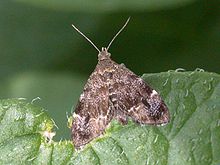
Choreutidae, or metalmark moths, are a family of insects in the lepidopteran order whose relationships have been long disputed. It was placed previously in the superfamily Yponomeutoidea in family Glyphipterigidae and in superfamily Sesioidea. It is now considered to represent its own superfamily (Minet, 1986). The relationship of the family to the other lineages in the group "Apoditrysia" [1] need a new assessment, especially with new molecular data.
Contents
1Distribution
2Behaviour
3Larval hostplants
4References
5Sources
6External links
Distribution
The moths occur worldwide, with 19 genera in three subfamilies defined by the structural characteristics of the immature stages (larvae and pupae), rather than the characters of the adults (Heppner and Duckworth, 1981; Rota, 2005).
Behaviour
These small moths often bear metallic scales[2] and are mostly day-flying (some also come to lights), with a jerky, pivoting behaviour, and may fluff up their wings at an extreme angle. Some tropical exemplars such as the genus Saptha are quite spectacular, with bright green metallic bands [3]. The members of the genus Brenthia, usually placed in their own subfamily Brenthiinae, have eyespots on the wings and have been shown to mimic jumping spiders (Rota and Wagner, 2006).
Larval hostplants
Most species skeletonize leaves often among silken webbing [4] whereas the western Palaearctic Millieria are leaf miners on the plant genus Aristolochia. Other Millieriinae (a subfamily defined mainly on larval characters) feed on palms (the genus Phormoestes on Sabal), whilst that of the Chilean genus Nyx is unknown. The foodplants of many Choreutinae occurring in the temperate region and some tropical species are known [5], being dominated by Asteraceae, Betulaceae, Boraginaceae, Dipterocarpaceae, Fabaceae, Labiatae, Moraceae (mainly Ficus), Rosaceae, Sapindaceae and Urticaceae. The European nettle-tap moth (Anthophila fabriciana Linnaeus, 1767), illustrated here [6] is a familiar sight pirouetting around "stinging nettles" Urtica and nearby flowers while Choreutis pariana[7] skeletonizes apple leaves. The last genus has 85 species worldwide one of which, C. tigroides, is a pest of "jackfruit" (Artocarpus) (Dugdale et al., 1999).
References
Dugdale, J.S., Kristensen, N.P., Robinson, G.S. and Scoble, M.J. (1999) [1998]. The smaller microlepidoptera grade superfamilies, Ch.13., pp. 217–232 in Kristensen, N.P. (Ed.). Lepidoptera, Moths and Butterflies. Volume 1: Evolution, Systematics, and Biogeography. Handbuch der Zoologie. Eine Naturgeschichte der Stämme des Tierreiches / Handbook of Zoology. A Natural History of the phyla of the Animal Kingdom. Band / Volume IV Arthropoda: Insecta Teilband / Part 35: 491 pp. Walter de Gruyter, Berlin, New York.
Heppner, J. B. and W. D. Duckworth (1981). Classification of the superfamily Sesioidea (Lepidoptera: Ditrysia). Smithsonian Contributions to Zoology314: 1-144.
Minet, J. (1986). Ébauche d'une classification moderne de l'ordre des Lépidoptères. Alexanor 14(7): 291-313.
Rota, J. (2005) Larval and Pupal Descriptions of the Neotropical Choreutid Genera Rhobonda Walker and Zodia Heppner (Lepidoptera: Choreutidae) Annals of the Entomological Society of America, 98: 37-47. Abstract
Rota, J. and Wagner, D.L. (2006). Predator Mimicry: Metalmark Moths Mimic Their Jumping Spider Predators. PLoS ONE, 1(1): e45. Published online 20 December 2006. doi:10.1371/journal.pone.0000045. Abstract/pdf
Clash Royale CLAN TAG #URR8PPP Ethnic group For the term for the region and its historical, geographical, demographic and political issues, see Northern Epirus. Northern Epirotes Βορειοηπειρώτες Total population est. over 215,000 (Greeks of southern Albania/Northern Epirus) Greeks of southern Albania/Northern Epirus (including those of ancestral descent) Regions with significant populations Albania, Greece, United States, Australia Albania and Greece est. over 200,000 [1] [2] [3] United States of America over 15,000 (est. 1965) [4] Languages Greek also Albanian and English depending on the residing place Religion Orthodox Christianity The Greeks of Albania are ethnic Greeks who live in or originate from areas within modern Albania. They are mostly concentrated in the south of the country, in the areas of the northern part of the historical region of Epirus, in parts of Vlorë County, [5] Gjirokastër,...
Clash Royale CLAN TAG #URR8PPP Ultra Electronics Holdings plc Type Public Traded as LSE: ULE Industry Defence, security, transport and energy Founded 1920 Headquarters Greenford, London, UK Area served Worldwide Key people Douglas Caster, Chairman Simon Pryce Chief Executive Products C4ISTAR Cyber security Sonar systems Civil transport and energy systems and equipment Equipment for defence and security applications Military aircraft equipment Civil aircraft equipment Ice Protection Revenue £775.4 million (2017) [1] Operating income £61.5 million (2017) [1] Net income £48.9 million (2017) [1] Number of employees 4,172 (2016) [1] Website www.ultra-electronics.com Ultra Electronics Holdings (LSE: ULE) is a British company serving the defence, security, transport and energy industries. It is listed on the London Stock Exchange and is a constituent of the FTSE 250 Index. Contents 1 History 2 Operations 3 Ultra subsidiary companies 4 See also 5 Reference...
Clash Royale CLAN TAG #URR8PPP This article is about a control panel placed in the front of the car. For other uses, see Dashboard (disambiguation). The dashboard of a Bentley Continental GTC car A dashboard (also called dash , instrument panel (IP) , or fascia ) is a control panel usually located directly ahead of a vehicle's driver, displaying instrumentation and controls for the vehicle's operation. Contents 1 Etymology 2 Dashboard features 3 Padding and safety 4 Fashion in instrumentation 5 See also 6 References Etymology Horse-drawn carriage dashboard Originally, the word dashboard applied to a barrier of wood or leather fixed at the front of a horse-drawn carriage or sleigh to protect the driver from mud or other debris "dashed up" (thrown up) by the horses' hooves. [1] Commonly these boards did not perform any additional function other than providing a convenient handhold for ascending into the driver's seat, or a small clip with which to secu...

 Clash Royale CLAN TAG#URR8PPP